The Hidden Cost of Lost Medical Records in Africa
Lost medical records affect millions of patients across Africa every year, leading to delayed treatment, repeated tests, higher healthcare costs, and poorer outcomes. Here's why healthcare systems must move beyond paper records.

VitaLink Technologies
Editorial Team
For many patients across Africa, visiting a healthcare facility often begins with a familiar question:
"Do you have your hospital card?"
If the answer is no, a difficult process often follows. Records may need to be searched manually, new files may be created, and valuable medical history can become inaccessible when it is needed most.
While this may seem like a routine administrative issue, the consequences of lost or inaccessible medical records extend far beyond paperwork.
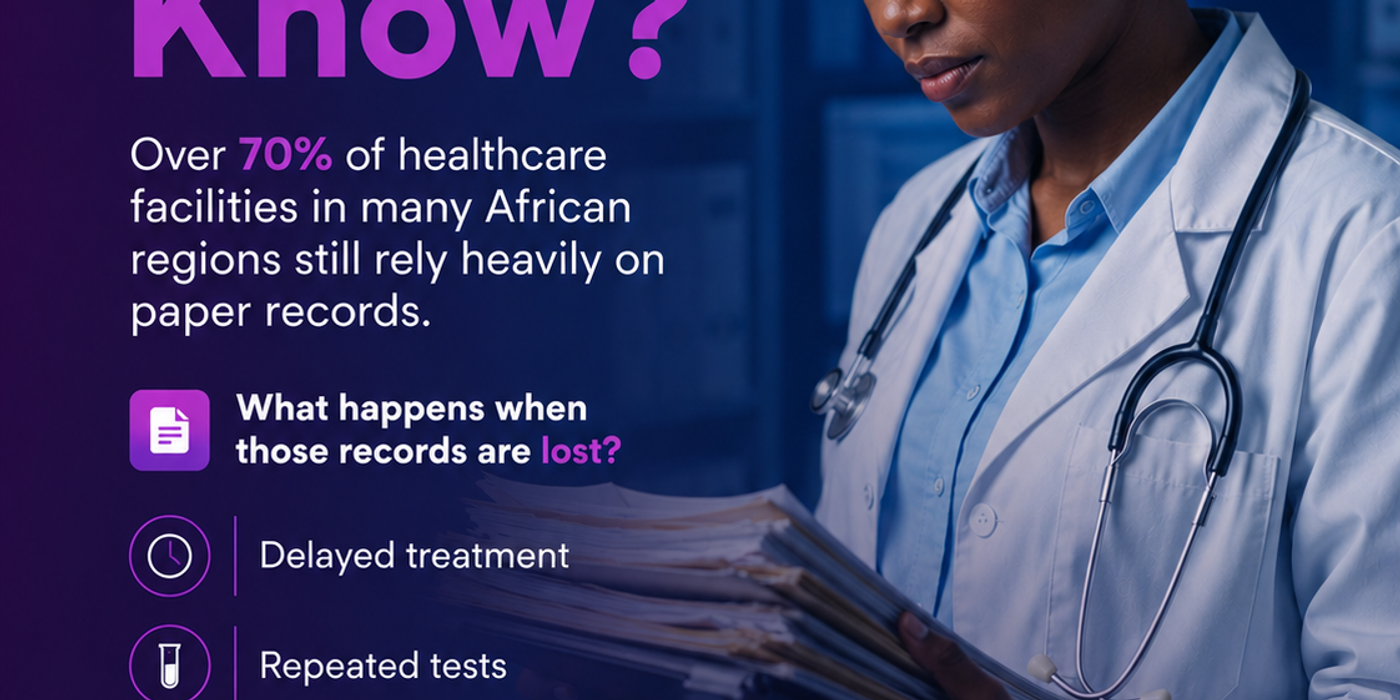
Lost records contribute to delayed treatment, repeated diagnostic tests, higher healthcare costs, and poorer health outcomes for millions of people every year.
As healthcare systems continue to grow and patient populations increase, the need for reliable, accessible health records has never been greater.
Why Medical Records Matter
A medical record is more than a collection of documents.
It tells the story of a patient's health journey.
Medical records contain critical information such as:
- Previous diagnoses
- Medications
- Allergies
- Laboratory results
- Vaccination history
- Surgical procedures
- Chronic conditions
- Treatment plans
Healthcare professionals rely on this information to make informed decisions.
When records are unavailable, clinicians are often forced to make decisions with incomplete information.
The Reality of Paper-Based Systems
Many healthcare facilities still depend heavily on paper records.
While paper systems have served healthcare providers for decades, they present significant challenges:
Records Can Be Lost
Files may be misplaced, damaged, or destroyed.
In some facilities, locating a patient file can take hours or even days.
Records Are Difficult to Share
When a patient visits another hospital, their medical history often does not follow them.
The new provider must start from scratch.
Storage Becomes a Challenge
As healthcare facilities grow, storing and organizing thousands of paper files becomes increasingly difficult.
Data Is Difficult to Analyze
Public health planning depends on reliable health data.
Paper systems make it difficult to identify disease trends, monitor outbreaks, and measure healthcare outcomes.
The Financial Cost
Lost medical records create hidden expenses throughout the healthcare system.
Patients may need to:
- Repeat laboratory tests
- Repeat imaging procedures
- Attend additional consultations
- Pay for duplicate services
Healthcare facilities also bear costs through:
- Administrative inefficiencies
- Increased staff workload
- Delayed patient flow
- Reduced operational productivity
These costs accumulate over time and place additional pressure on already stretched healthcare systems.
The Impact on Patient Care
The most significant cost is often measured in health outcomes.
Without access to accurate medical histories:
- Allergies may be missed
- Chronic conditions may go undocumented
- Medication interactions may go unnoticed
- Treatment plans may be interrupted
In emergency situations, the absence of critical medical information can significantly affect clinical decision-making.
Every delay matters when lives are at stake.
The Public Health Challenge
Healthcare records do not only benefit individual patients.
They also play a vital role in public health.
Reliable health data helps organizations:
- Track disease outbreaks
- Monitor vaccination coverage
- Identify health trends
- Allocate healthcare resources effectively
- Improve emergency response
When records remain fragmented or inaccessible, public health agencies lose valuable visibility into population health.
Moving Toward Digital Health Infrastructure
Healthcare systems around the world are increasingly adopting digital solutions to improve continuity of care.
Electronic Medical Records (EMRs) provide healthcare providers with secure access to patient information while reducing many of the limitations associated with paper-based systems.
Benefits include:
- Faster access to patient information
- Improved care coordination
- Reduced duplication of tests
- Better data security
- Enhanced reporting and analytics
- Stronger public health insights
Most importantly, digital records help ensure that healthcare information follows the patient—not the facility.
Building the Future
The future of healthcare depends on connected, accessible, and secure health information.
Patients should not have to repeat their medical history at every visit.
Healthcare providers should not spend valuable time searching for files.
Public health agencies should have access to reliable data that supports informed decision-making.
The transition from paper records to digital infrastructure is not simply a technology upgrade, it is an investment in better healthcare outcomes.
At VitaLink, we believe every patient deserves continuity of care, every healthcare provider deserves better tools, and every healthcare system deserves the infrastructure needed to deliver quality healthcare at scale.
Conclusion
Lost medical records are more than an administrative inconvenience.
They represent a barrier to efficient, affordable, and effective healthcare.
By investing in modern healthcare infrastructure, we can build systems where information is available when it matters most—improving care for patients, supporting healthcare providers, and strengthening public health across Africa.
VitaLink — Connecting Healthcare. Empowering Lives.